
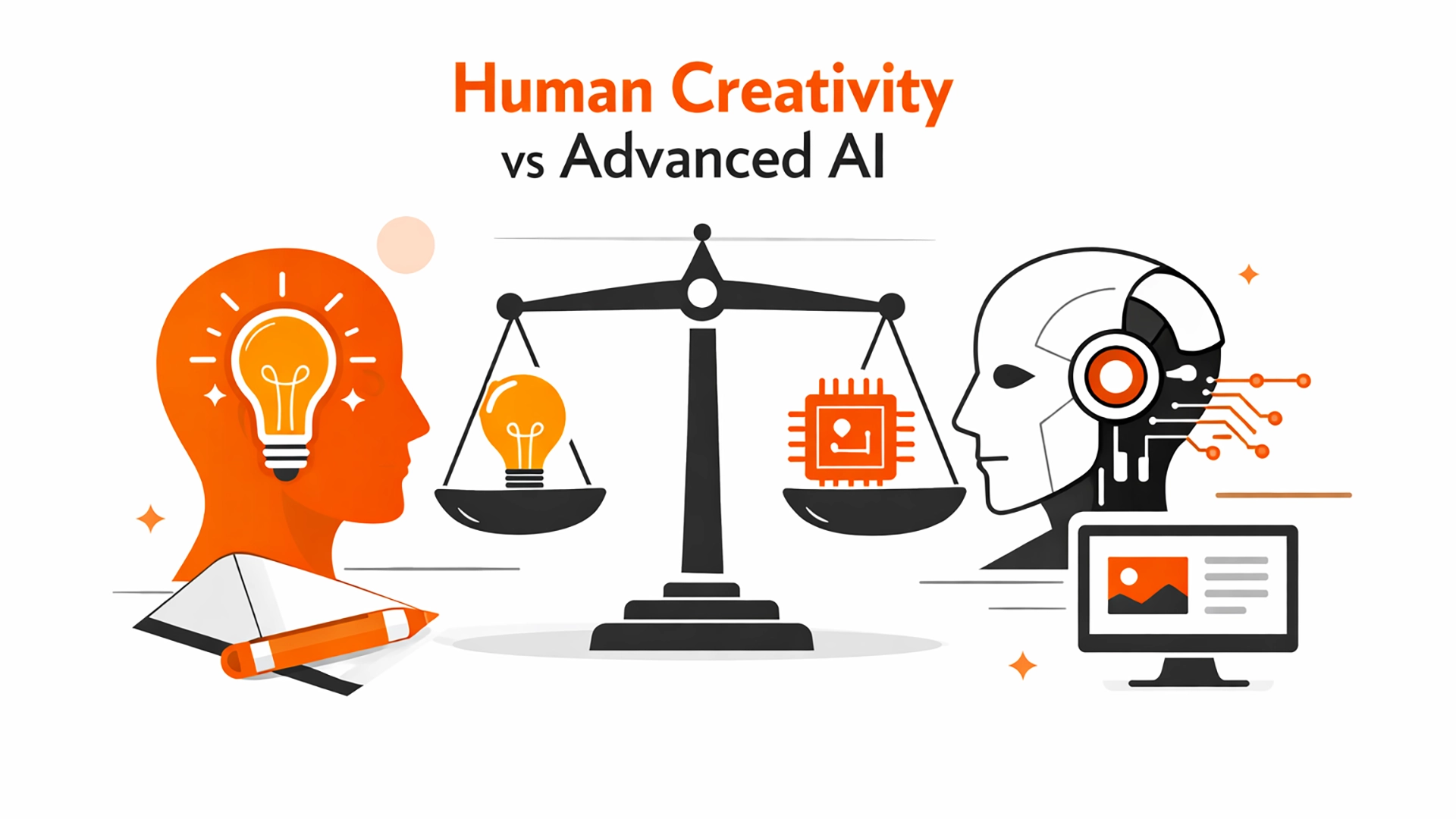
Why Human Creativity Still Matters in the Age of Advanced AI
Artificial intelligence has changed how we work, create, and think. Tasks that once took hours can now be completed in minutes. Designs can be generated instantly. Content can be written at scale. Decisions can be assisted by data.
Yet, despite all this progress, one thing remains unchanged:
We still depend on human judgment, human taste, and human intent.
AI can accelerate execution.
But it cannot replace meaning.
AI is a Tool, Not a Mind
AI is powerful because it processes patterns at scale. It learns from vast amounts of existing data and produces outputs based on probability and structure.
But that’s also its limitation.
AI does not:
- Understand context the way humans do
- Experience emotion
- Hold values or beliefs
- Take responsibility for decisions
It generates based on what exists.
It does not originate from lived experience.
This distinction matters.
Because creation is not just about producing something.
It is about why it exists.
The Role of Human Intent
Every meaningful piece of work begins with intent.
A website is not just a layout.
It is a representation of a business, a vision, and a promise.
A film is not just a sequence of frames.
It is perspective, emotion, and interpretation.
A brand is not just visuals.
It is perception shaped over time.
AI can assist in building these outputs.
But it cannot define their purpose.
That comes from human thinking.
Creativity is More Than Output
There is a common misconception that creativity is about producing something new.
In reality, creativity is about:
- Choosing what to say
- Deciding what to leave out
- Understanding what matters
- Connecting ideas in meaningful ways
These are not mechanical processes.
They require:
- Awareness
- Sensitivity
- Experience
AI can generate variations.
But it does not know which one feels right.
That decision still belongs to humans.
The Importance of Taste and Judgment
In a world where AI can generate endless options, the real value shifts from creation to selection.
The question is no longer:
“Can this be created?”
The question becomes:
“Should this exist?”
This is where human taste becomes critical.
Good design, strong storytelling, and effective communication all rely on judgment.
Not everything that can be made should be used.
Knowing the difference is what defines quality.
The Risk of Over-Reliance on AI
As AI becomes more accessible, there is a growing tendency to depend on it for direction, not just execution.
This leads to:
- Generic outputs
- Loss of originality
- Lack of clear identity
When everyone uses the same tools in the same way, everything begins to look and feel the same.
The role of the human creator is to break that pattern.
To question.
To refine.
To bring clarity where there is noise.
Where AI Truly Helps
This is not an argument against AI.
Used correctly, AI is a powerful partner.
It helps with:
- Speed
- Efficiency
- Exploration
- Repetitive tasks
It allows creators to focus more on thinking and less on execution.
But it works best when guided.
AI performs well when:
- The direction is clear
- The intent is defined
- The human remains in control
The Future is Collaborative, Not Replaced
The future is not about humans versus AI.
It is about humans working with AI.
AI will handle:
- Scale
- Automation
- Data-driven processes
Humans will continue to lead:
- Vision
- Creativity
- Decision-making
The balance between the two will define the quality of work.
Why Human Touch Still Matters
At the core of everything we create is connection.
People respond to:
- Authenticity
- Emotion
- Clarity
- Story
These are human qualities.
No matter how advanced technology becomes, people still connect with people.
That is why human touch is not optional.
It is essential.
Final Thought
AI will continue to evolve.
It will become faster, smarter, and more capable.
But the value of human creativity will not diminish.
It will become more important.
Because in a world where everything can be generated,
what truly stands out is what is thoughtfully created.
Hi, really liked how clearly this was explained, especially the distinction between execution and intent.
One thing that stood out to me is how AI makes creation easier, but actually increases the importance of human judgment. When everything can be generated, the real skill shifts to deciding what should be created and what should not be.
I’ve been experimenting with AI tools for building websites and content, and I’ve noticed that without clear direction, the output quickly becomes generic. The difference really comes from how the idea is shaped and refined, not just generated.
I think this balance between speed (AI) and clarity (human thinking) is going to define the quality of work going forward.
Really appreciate you taking the time to share this. You’ve captured the core of it very well.
That shift you mentioned, from execution to judgment, is exactly what we’re seeing too. AI has removed a lot of the friction in “making,” but it hasn’t replaced the responsibility of deciding what is worth making in the first place. If anything, that responsibility has become heavier.
Your point about outputs becoming generic without clear direction is something many people overlook. The tools are powerful, but they tend to average things out unless guided with intent. That’s where human perspective, taste, and even restraint start to matter more than ever.
The balance you described between speed and clarity is likely where meaningful work will stand apart. Speed can produce volume, but clarity gives it identity.
Would be interesting to hear more about what you’ve been building with AI and where you’ve felt that difference most.
Thanks again for the thoughtful comment.
Strong perspective. AI can generate content, but without human intent and direction, it quickly loses meaning. That’s where real creativity still matters.
The pricing examples make a big difference. Now I can see why some websites cost more than others.