
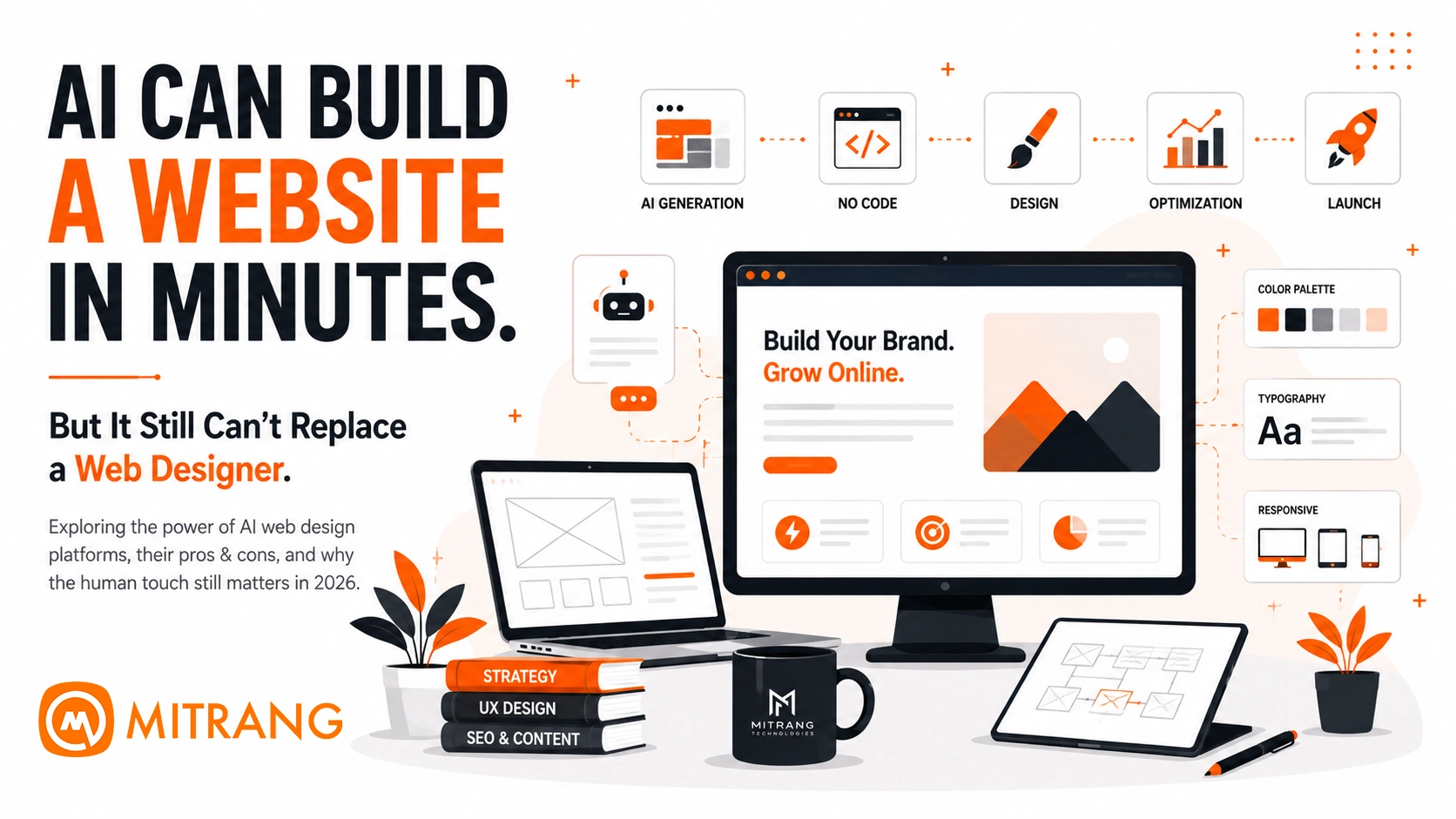
AI Can Build a Website in Minutes. But It Still Can’t Replace a Web Designer.
When I started Mitrang.com in 2010, building a professional website was a long process.
Every project began with conversations. We tried to understand the client’s business, their audience, their goals, and what made them different. Then came planning, wireframing, design, development, testing, revisions, and finally deployment.
A simple business website could take weeks.
If someone had told me back then that one day you could simply type:
“Build me a modern website for my restaurant with online ordering and a reservation system.”
…and have a complete website generated in under five minutes, I would probably have laughed.
Yet here we are in 2026.
Artificial Intelligence has completely changed how websites are designed and built. Today, AI can generate layouts, write copy, create images, suggest colour palettes, optimise SEO, write code, and even deploy websites with little or no human intervention.
It is one of the biggest shifts the web industry has seen since the rise of WordPress.
But while AI has become incredibly powerful, it has not replaced good designers or developers.
It has simply changed how they work.
The Rise of AI Website Builders
Today’s AI website platforms generally fall into three categories:
1. Design-first Platforms
These focus on creating beautiful marketing websites with visual editing.
Popular examples include:
- Framer AI
- Webflow AI
- Wix AI / Wix Studio
- Squarespace AI
These are excellent for portfolios, company websites, landing pages and personal brands. They combine AI generation with drag-and-drop editing for greater design control.
2. AI-native Website & App Builders
Instead of templates, these generate actual code from natural language prompts.
Popular platforms include:
- Lovable
- Bolt.new
- Vercel v0
- Replit Agent
- Base44
These tools are ideal for startups, MVPs, SaaS products and prototypes because they can generate working applications, not just static websites.
3. AI-enhanced Traditional Builders
Platforms like:
- WordPress (AI plugins)
- 10Web
- Hostinger AI Website Builder
- Durable
These make website creation easier while still relying on traditional website-building workflows.
What AI Does Extremely Well
There is no denying the advantages.
Incredible speed
A landing page that once took several days can now be generated in minutes.
Rapid prototyping
Businesses can validate ideas before investing heavily in development.
Content generation
AI produces headlines, service descriptions, FAQs, blogs and product pages remarkably quickly.
Responsive layouts
Most modern AI builders automatically create mobile-friendly websites.
Coding assistance
Developers can generate components, debug code and build features much faster than before.
Lower entry barrier
Small businesses can launch professional-looking websites without hiring an entire development team.
For entrepreneurs with limited budgets, this is revolutionary.
But AI Also Has Serious Limitations
This is where reality begins.
Many people see AI create an impressive homepage and assume the job is finished.
It isn’t.
Generic designs
Many AI-generated websites look surprisingly similar.
Rounded buttons.
Large hero images.
Soft gradients.
Minimal layouts.
After browsing enough AI-generated sites, they begin to blend together. Even newer AI models are being developed specifically to reduce this “AI look.”
Limited understanding of business strategy
AI can build pages.
It cannot truly understand:
- why customers buy
- what makes your company unique
- local market behaviour
- brand positioning
- emotional storytelling
These require human insight.
Weak branding
A logo is not a brand.
Colours are not a brand.
Typography is not a brand.
Brand identity is built through consistency, psychology and storytelling.
AI helps execute branding.
Humans create it.
SEO still needs experts
AI can generate SEO-friendly text.
But real SEO also involves:
- keyword research
- search intent
- technical optimisation
- site architecture
- internal linking
- performance optimisation
- ongoing monitoring
Those decisions still require experience.
Accessibility issues
Many AI-generated websites overlook accessibility standards.
Good web design ensures websites are usable for everyone, including people with disabilities.
Security concerns
When AI writes code, it may also introduce security vulnerabilities.
Generated code should always be reviewed before deployment.
Difficult customisation
The first version often looks impressive.
The tenth revision becomes harder.
Many users discover that making complex changes is more difficult than creating the initial website.
The Biggest Myth About AI
Many believe AI replaces designers.
It doesn’t.
It replaces repetitive work.
Think about photography.
Smartphones didn’t eliminate professional photographers.
They eliminated the need to hire photographers for every small occasion.
Professional photography still exists because experience, creativity and vision matter.
The same is true for web design.
Where Human Designers Still Win
Experienced designers ask questions AI cannot.
Who is your audience?
Why should customers trust you?
What emotions should your website create?
How should users move through your sales journey?
Which content should appear first?
How can we improve conversion rates?
Those answers don’t come from prompts.
They come from experience.
My Experience Since 2010
When I founded Mitrang.com, every pixel was designed manually.
Today, AI handles many of those repetitive tasks.
Instead of spending hours creating initial layouts, I can focus on solving business problems.
Instead of writing boilerplate code, I spend more time improving user experience.
Instead of replacing creativity, AI gives me more time to be creative.
That is the real transformation.
My Advice to Businesses
If you’re planning a new website, don’t ask:
“Can AI build my website?”
Ask instead:
“How can AI help build a better website?”
Use AI for:
- generating first drafts
- brainstorming ideas
- speeding up development
- creating content
- testing layouts
But let experienced professionals guide:
- strategy
- branding
- UX
- SEO
- performance
- security
- final quality assurance
The best websites in 2026 are not built by AI alone.
They are built through collaboration between artificial intelligence and human intelligence.
Final Thoughts
AI has changed web design forever.
There is no going back.
The agencies that refuse to embrace AI will fall behind.
But businesses that rely entirely on AI may also discover its limitations.
Technology can generate a website.
Only people can build trust.
Only people understand emotion.
Only people truly understand other people.
And that is why, even in the age of AI, the human touch remains the most valuable part of every great website.
by: Vir Bhadra Yumnam